Instrumentation
Instrumentation
The department has a strong focus on cutting-edge astronomical instrumentation, spanning optical, infrared, and radio wavelengths. Roberto Abraham has developed the Dragonfly Telephoto Array and is leading the construction of MOTHRA, a hyperspectral robotic array designed to study low-surface-brightness galaxies and the circumgalactic medium. Suresh Sivanandam works on next-generation infrared spectrographs and adaptive optics systems, including WIFIS and GIRMOS, enabling high-resolution studies of galaxies, stellar populations, and the high-redshift universe. Sivanandam also leads the LUVCam and LUVCam2 cube-sat telescope efforts. These projects highlight how instrumentation and science goals are closely linked, with new technology unlocking observations previously beyond reach.
In the radio and submillimeter regime, the department is advancing large-scale cosmological and transient surveys. Juan Mena Parra leads the development of CHIME, CHORD, and CHARTS, providing world-leading capabilities to map large-scale structure, detect fast radio bursts, and probe dark energy. Keith Vanderlinde works on the commissioning and science exploitation of these facilities, ensuring high-precision measurements and reliability for long-term surveys. Similarly, Norman Murray and collaborators are involved with CCAT, developing instrumentation to map CO and [C II] emission across wide fields and a range of redshifts. Ue-Li Pen and Marten van Kerkwijk pioneer the technique of radio scintellometry to probe pulsars and the interstellar medium.
The department also emphasizes innovative detector technologies and instrumentation pipelines. Laurie Rousseau-Nepton has built the SIGNALS survey using SITELLE with imaging Fourier transform spectroscopy, and is advancing MKID-based IFTS prototypes for high-resolution, wide-field spectroscopy. Dae-Sik Moon develops novel polarization gratings and broad-band spectroscopic devices, while Adam Hincks applies machine learning to optimize CMB data processing. Across all wavelengths, these efforts demonstrate the department’s commitment to building instruments that push the boundaries of observational astrophysics, enabling transformative science from nearby stars to the distant cosmos.
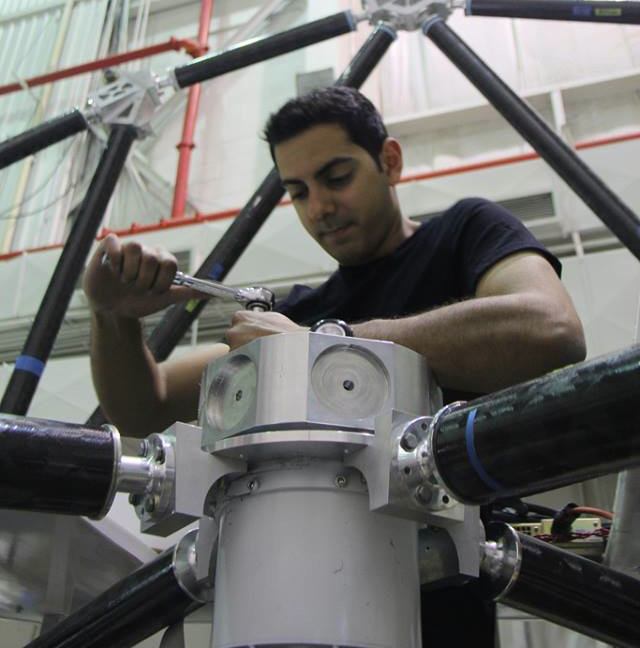
Department members utilize instruments for optical, infrared, radio telescopes, and balloon-borne experiments.
Roberto Abraham
Adam Hincks (DAA & St. Michael’s)
Juan Mena Parra (DAA & Dunlap)
Dae-Sik Moon
Barth Netterfield (DAA & Physics)
Ue-Li Pen (CITA)
Norman Murray (CITA)
Laurie Rousseau-Nepton (DAA & Dunlap)
Suresh Sivanandam (DAA & Dunlap)
Marten van Kerkwijk
Keith Vanderlinde (DAA & Dunlap)