Delta Cephei
The first example to be analyzed is the star Delta Cephei. This is the prototype Cepheid variable. It is observable with the naked eye and has a short period which makes it easy to observe many cycles. It has a very regular period as well which makes the analysis much easier. The data used here was obtained from the Hipparcos website.
The first step in analyzing a variable star is to produce a light curve. This is simply a plot of the magnitude versus the time (shown here is the Julian Date format). The magnitude scale is reversed to have the brightest at the top.
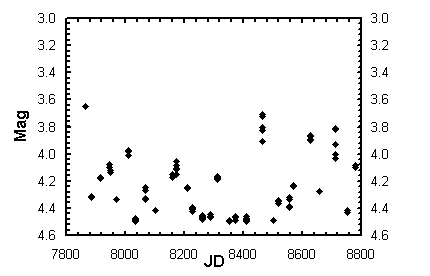
Delta Cephei Light Curve
This is a good example of how a light curve is not always sufficient for determining a period. No obvious period stands out here so it is most likely that we are not looking at the right time scale. The large spaces in the data make it pointless to zoom in on a smaller section and so different methods must be used.
The next step is to use the programs available in the analysis section. The next graph shows the results from running the data through the self-correlation program Astrolab. The peaks and minima indeed show that we were using too large of a time scale in the light curve. The minima occur at approximately 5 days apart from each other. There are some that are around 10 days apart but this is most likely because of gaps in the data.
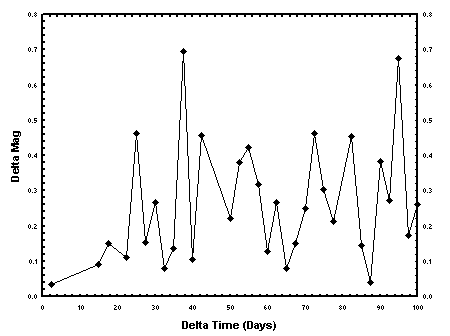
Delta Cephei Self-Correlation
Performing a Fourier analysis on the data is often useful to confirm these results. This was done using TS11. In this case the period is confirmed to be 5.366 days. The result with the highest power is the best fit to the data. If you were unsure in the last case if the period was 5 or 10 days this graph makes it much more obvious. The appearance of other large peaks could be caused by the gaps in the data or from discordant points in the light curve.
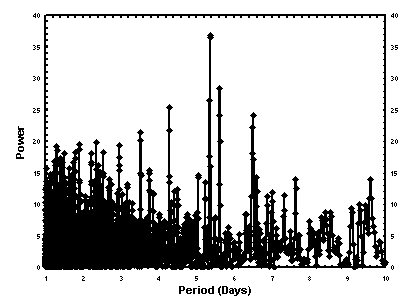
Delta Cephei Fourier analysis
Once you have a possible period a good check of the data is to create a phase diagram. This is a plot of the magnitude versus phase (between 0 and 1) relative to the suspected period. Using a period of 5.366 days, the phase diagram shows very little scatter which indicates that the period has been a good choice.
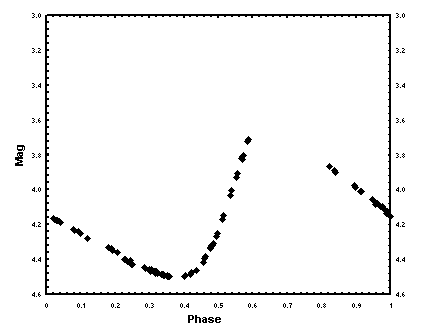
Delta Cephei Phase Diagram
A light curve from the AAVSO website of the star shows what the variations look like with more frequent observations and a smaller timescale in the visual range. The variations become very pronounced and a period is quite obvious.
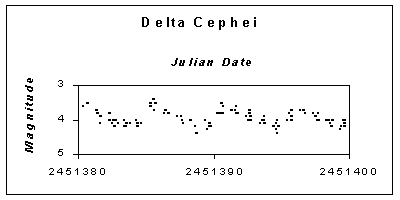
light curve from AAVSO website
EU Del
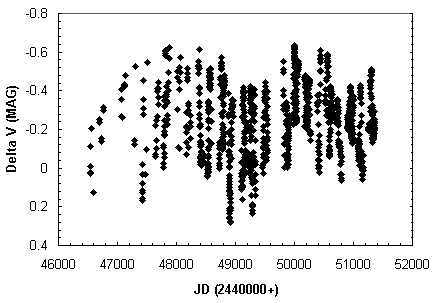
EU Del Light Curve
Since this star seems to behave mono-periodically, it will be useful to
perform self-correlation analysis on it.Below
is the result of running the data through Astrolab.The
minima occur every 60-63 days, so we know that the period is within this
range.
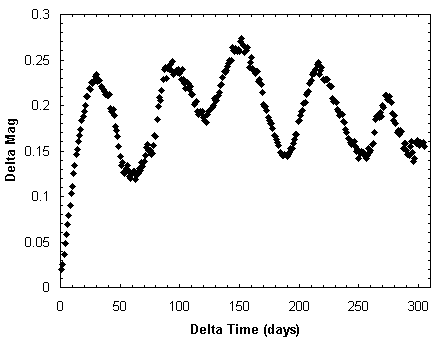
EU Del Self-Correlation
Running the original data through TS11 will enable us to determine the period more precisely.Below is the power spectrum of the data.The period is confirmed to be 62.3 days, which is indicated by the pronounced peak in the graph.
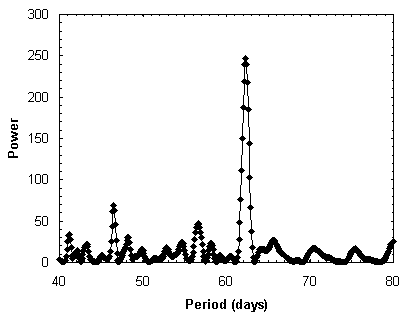
EU Del Fourier Analysis
Using
a period of 62.3, a phase diagram was generated.It
looks reasonably good, as a further confirmation of the 62.3 day period.
There is some scatter in the phase diagram
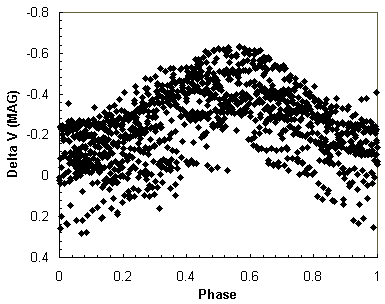
EU Del Phase Diagram