Home Page of Slavek Rucinski
Professor Emeritus at the Department of Astronomy
Updated in November 2024
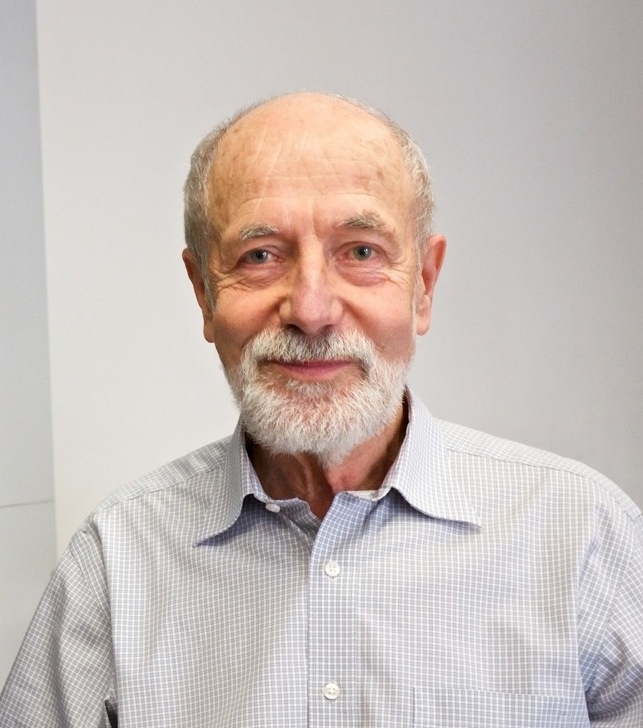
I have been retired since July 2009, but I try to continue my research
to some extent given my current health restrictions. You
may wish to peruse my shortened CV.
In short, my professional life spanned between Warsaw, Poland (1965 - 1984)
and Toronto, Canada (1984 - now), but with several longer stays in other
places: Post-Doc in Gainesville, Florida (1970 - 1971), the Plaskett Fellowship
( apparently the first awarded) in the Dominion Astrophysical Observatory,
Victoria, B.C. (1975 - 1977), Max Planck Institute,
Munich (1980 - 1982), and the Institute of
Astronomy, Cambridge University (1982 - 1984).
I was associated with the University of Toronto for
most of my life after our emigration to Canada in 1984.
In 1999 - 2008, I managed the David Dunlap Observatory (DDO)
before its closure on July 2, 2008. I retired in 2009.
In years 1987 - 1997, I worked in the Institute for Space and Terrestrial Science
which was one of the Centres of Excellence of the Province of Ontario
and in 1997 - 1998, for 1.5 years, I was the Canadian Resident Astronomer
at the Canada-France-Hawaii Telescope in Hawaii.
A Wikipedia
article gives similar information as the current page, but in Polish.
An interview for The Star Formation Newsletter edited by Dr. Bo Reipurth
is focused on my work on young stars.
Documents of possibly archival value.
Research activities
My research has been related mostly to the problem of the angular
momentum evolution in binary stars, from the stage of formation to their coalescence.
I also worked some time ago on the interstellar polarization,
star formation, proto-stellar disks and stellar
atmospheres, but most of my work currently is related to binary stars,
especially contact binary stars. The last, larger project done at the David Dunlap
Observatory using the DDO 1.88m telescope was
a systematic spectroscopic survey of bright close binary stars with periods
shorter than 1 day.
I developed the Broadening Function approach
for the DDO spectroscopic data and for similar uses;
it gives far superior results to the Cross-Correlation Function for
de-convolution of complex, rich, strongly rotationally-broadened spectra.
The
MOST satellite project
ended its long and profitable life in 2014 and I am now very involved in
another satellite project
BRITE
which was also started in Canada. I was
the early leader of the Canadian team of the BRITE Canadian Team
(see a PDF description)
and am now a member of the international committee overseeing BRITE Constellation operations.
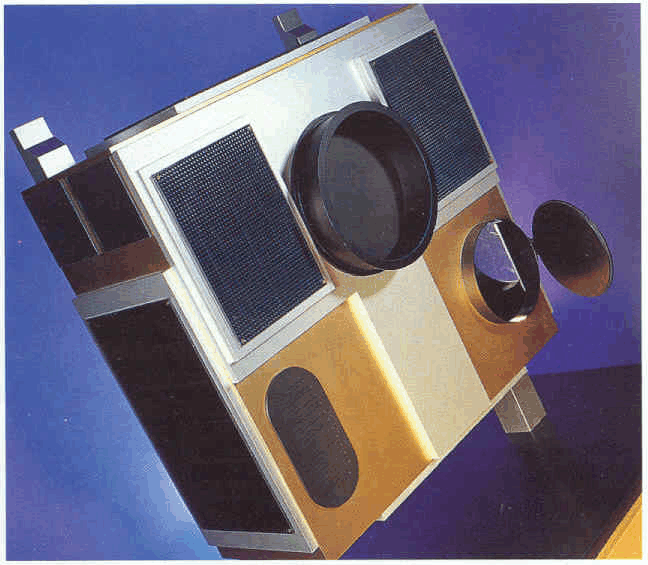 A successful proposal to the Canadian Space Agency in 1997
(with Dr. Kieran Carroll of Dynacon, Toronto and University of Toronto
Institute for Aerospace Studies (UTIAS)) initiated the MOST micro-satellite
project.
The MOST project has been led by Prof.J.Matthews at the
University of British Columbia (see:
UTIAS Space Flight Lab,
Dynacon in Toronto).
The satellite was launched in 2003 and was funded through 2014.
It may still work, although the progressively diminishing
solar-panel efficiency has by now crossed the minimum output threshold.
In addition to about 200 individually targeted
observations lasting typically a few weeks,
the satellite observed over 2000 secondary targets which remain to be
analyzed.
A successful proposal to the Canadian Space Agency in 1997
(with Dr. Kieran Carroll of Dynacon, Toronto and University of Toronto
Institute for Aerospace Studies (UTIAS)) initiated the MOST micro-satellite
project.
The MOST project has been led by Prof.J.Matthews at the
University of British Columbia (see:
UTIAS Space Flight Lab,
Dynacon in Toronto).
The satellite was launched in 2003 and was funded through 2014.
It may still work, although the progressively diminishing
solar-panel efficiency has by now crossed the minimum output threshold.
In addition to about 200 individually targeted
observations lasting typically a few weeks,
the satellite observed over 2000 secondary targets which remain to be
analyzed.
 In 2003, prompted by a question of Dr.R.Zee from the
UTIAS Space Flight Lab,
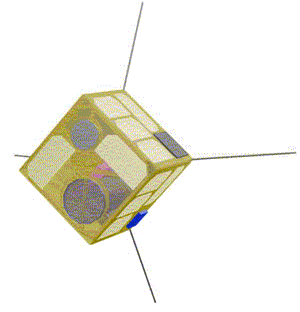
I initiated a project to develop a very small nano-satellite
for astronomy, the "BRIght Target Explorer", or "BRITE".
A single BRITE is a cube with side dimensions of 20cm and
with a small lens telescope. The goal was to observe
variability of at least 300 brightest stars to 3.5-4.5 magnitude
with accuracy better than 0.1%. Paradoxically,
variability of the brightest stars has been relatively poorly
known due to difficulties with relative photometry
over large angular distances in the sky, in the presence of variable
atmospheric extinction and thin clouds.
Majority of the brightest stars in the sky are in fact the ones which
are intrinsically the most luminous as the huge range in stellar luminosities
easily over-compensates for the Euclidian 1/r^2 effect. Thus, the
project main targets are massive, luminous, short-living stars
which are of the
highest importance for evolution of the Universe in terms of production and
enrichment of the matter in elements beyond the cosmologically created
hydrogen and helium.
BRITE is one (
CanX-3) in a series nano-satellites built at
UTIAS.
In 2003, prompted by a question of Dr.R.Zee from the
UTIAS Space Flight Lab,
I initiated a project to develop a very small nano-satellite
for astronomy, the "BRIght Target Explorer", or "BRITE".
A single BRITE is a cube with side dimensions of 20cm and
with a small lens telescope. The goal was to observe
variability of at least 300 brightest stars to 3.5-4.5 magnitude
with accuracy better than 0.1%. Paradoxically,
variability of the brightest stars has been relatively poorly
known due to difficulties with relative photometry
over large angular distances in the sky, in the presence of variable
atmospheric extinction and thin clouds.
Majority of the brightest stars in the sky are in fact the ones which
are intrinsically the most luminous as the huge range in stellar luminosities
easily over-compensates for the Euclidian 1/r^2 effect. Thus, the
project main targets are massive, luminous, short-living stars
which are of the
highest importance for evolution of the Universe in terms of production and
enrichment of the matter in elements beyond the cosmologically created
hydrogen and helium.
BRITE is one (
CanX-3) in a series nano-satellites built at
UTIAS.
A PPT
presentation from 2005
gives a description of the original idea; for further
design features, please consult other pages given there.
The Canadian BRITE's were the last to be funded: The
Austrian colleagues have been able to arrange funding for
two BRITE satellites in 2009; they
were launched in 2013 and 2014. Poland secured funding soon after and added
two
satellites to form the BRITE constellation; the satellites
"Lem" and "Heweliusz" were launched in 2013 and 2014.
Since August 2014, the BRITE Constellation consists of 5 satellites
with only one Canadian satellite "Toronto"; unfortunately, the second satellite,
"Montreal" did not separate from its launching rocket.
There have been interest from other countries
in joining the constellation.
For more information about the early history of the BRITE project,
read a few old
documents (PDF) .
By the decision of the President of Poland in May 2015, I was decorated
in September 2015 by the
Officer's Cross of the Order of Polonia Restituta
for my contributions to bringing the BRITE project to Poland; the nano-satellites
"Lem" and "Heweliusz" have been the first Polish research satellites.
I have been the member of the Polish Astronomical Society since 1966,
of the International Astronomical Union since 1973 and
of the Canadian Astronomical Society since 1985.
I was the Vice President (2003) and then President (2006)
of the International Astronomical Union
Commission 42 (Close Binary Stars).
The Polish Astronomical Society elected me as one of their
Honorary Members in 2019.
Publications and citations
In the middle of November 2024, my publications
according to the NASA Astrophysics Data System (ADS) database
acquired the following indicators:
- Total number of authored or co-authored publications: 465
- Total number of publications in refereed journals: 322
- Total number of citations: 14,129
- Total number of citations in refereed journals: 13,252
- Total number normalized citations (per one author): 6,306
- Total number normalized citations (per one author) in refereed journals: 5,700.5
- Index "h": 64
Most of the publications are accessible through the ADS database, although
access to the recent ones may be restricted to only through libraries.
Material related to my research (of limited general interest):
- The short-period binary-star RV-orbits program at DDO:
A brief description, all 15 main publications and other papers
(.pdf), and tables (.txt) with the published RV data.
- The Broadening Function determination: The
"cookbook" and the IDL routines.
- A very convenient Windows interface prepared by Bob Nelson to evaluate
broadening functions "Broad15.exe" (right click to save the WinZip file
BobNelson.zip).
- The data for the 7.5 magnitude sample of short period binaries: Table 1 in 2002, PASP, 114, 1124.
- The amplitude distribution for contact binaries: The tables in 2001, AJ, 122, 1007.
- The long-period EB-type systems in the Small Magellanic
Cloud: Table 1 in 2001, AJ, 121,
254.
- WUMa systems in globular clusters: The tables in
2000, AJ, 120, 319.
- WUMa, galactic-disk systems in the BW sample and in open clusters: The tables in the paper comparing the
Baade's Window sample with the open clusters sample, 1998, AJ, 116, 2998)
- Fourier coefficients and eclipse depths for WUMa
systems: The tables in 1993, PASP, 105,
1433.
- Results for contact systems in the direction of Baade's
Window: Tables in papers OGLE-1 and -2: 1997,
AJ, 113, 407 and 1112
- Fourier coefficients and depth of minima for hot contact systems: Tables in OGLE-3 paper, 1998, AJ, 115,
1135.
- The Hipparcos based calibration (RD97): Table 1 of the data in 1997, PASP, 109,
1340 (with H.W. Duerbeck).
Contact Me:
The postal address is:
Department of Astronomy & Astrophysics
University of Toronto
50 St. George Street
Toronto, Ontario, Canada M5S 3H4.
For contact, please use my
e-mail: slavek.rucinski_AT_utoronto.ca
(replace _AT_ by the correct character)
(Return to Department of Astronomy
homepage)